The Things We Break, and the God Who Restores

On the Apostle Peter, the courage of repentance, the wounds we leave upon those we love, and the extraordinary mercy of a God who calls us to begin again.
There are moments in life when the most painful truth we must confront is not what someone else has done to us, but what we have done to someone else.
Moments when the silence between two people becomes heavier than any argument. When the warmth of a familiar voice is replaced by distance. When someone who once looked at us with unquestioning trust begins to look at us with uncertainty.
And perhaps most painfully, moments when we realize that we are the reason.
We spend so much of our lives trying to become people worthy of love. We cultivate our gifts, nurture our relationships, build our reputations, and surround ourselves with the reassuring belief that our intentions are good. We want to think of ourselves as honest, faithful, compassionate people.
But what happens when our actions betray those very convictions?
What happens when we become the source of suffering in the lives of those we would have sworn never to hurt?
What happens when the person we love no longer knows whether to believe us?
These are not comfortable questions. They do not lend themselves to easy answers or beautiful explanations. And yet, somewhere within their discomfort, we find ourselves standing at the threshold of one of Christianity's most profound mysteries: the mystery of repentance, forgiveness, and the God who restores what human weakness has broken.
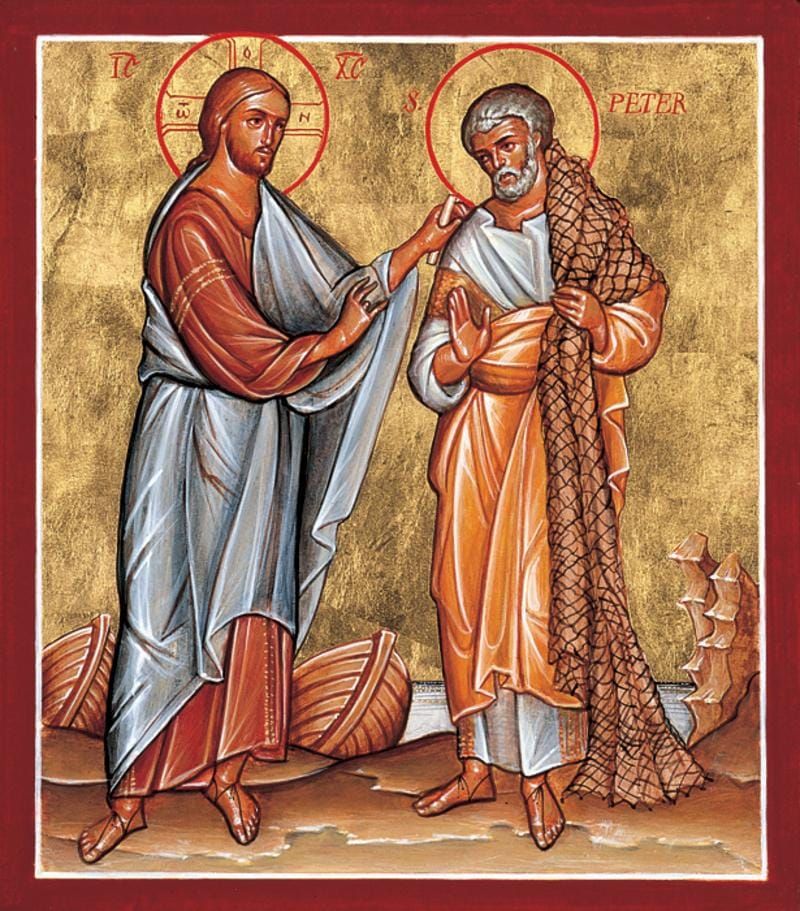
Perhaps nowhere is this mystery revealed more tenderly than in the encounter between the risen Christ and the Apostle Peter on the shores of the Sea of Tiberias.
It is a story about betrayal.
But more importantly, it is a story about what becomes possible after betrayal.
It is about a man who believed himself incapable of falling, a God who knew otherwise, and a love that did not cease to exist simply because it had failed.
I. The Man Who Promised He Would Never Fall
There is something almost unbearable about the story of the Apostle Peter.
Peter was not a stranger to Christ. He was not an indifferent observer or a man who had never experienced the tenderness of divine love.
He had walked with Him.
He had witnessed the blind receive their sight, the sick find healing, and the dead return to life. He had heard the voice that quieted storms. He had seen the glory of the Transfiguration.
And Peter loved Him.
Of this, there can be little doubt.
Yet love, even sincere love, does not make us incapable of terrible failure.
On the night of Christ's betrayal, Peter declared with remarkable confidence that he would never abandon his Lord.
"Even if I have to die with You, I will not deny You!" (Matthew 26:35).
How familiar those words are to the human heart.
I would never hurt you.
I would never betray your trust.
I would never become the person who causes you pain.
We speak such promises with sincerity. We may even believe them completely.
But there is a dangerous distance between the person we imagine ourselves to be and the person we reveal ourselves to be when fear, temptation, or self-preservation takes hold.
Peter had gone even further. When Christ foretold that His disciples would stumble, Peter insisted that even if everyone else abandoned Him, he would remain faithful.
His confidence was not merely in his love for Christ.
It was in his own ability to love better than the others.
And there, perhaps, was the beginning of his fall.
For it is possible to love sincerely and still misunderstand the weakness of one's own heart.
It is possible to possess genuine affection while lacking the humility necessary to protect it.
It is possible to make promises that are beautiful, even sacred, and yet fail to recognize how much courage their fulfillment will require.
Before the night was over, Peter had denied knowing Christ.
Not once.
Three times.
And then the rooster crowed.
Saint Luke tells us that the Lord turned and looked at Peter. Remembering what Christ had foretold, Peter went outside and wept bitterly (Luke 22:61–62).
Scripture does not tell us everything contained in that look.
Was there sorrow? Compassion? The terrible tenderness of a love that had already known the betrayal was coming?
Perhaps the silence of Scripture is itself an invitation to contemplate what words cannot contain.
But we know what happened to Peter.
He wept.
And there is something profoundly human about those tears.
They were the tears of a man who could no longer reconcile his promises with his actions. The tears of someone forced to confront the fragility of his own convictions.
Peter had not merely disappointed someone he loved.
He had discovered something frightening about himself.
And perhaps that is where repentance truly begins.
Not when we are embarrassed that our wrongdoing has been discovered.
Not when we fear losing the affection or respect of others.
But when we finally recognize the wound we have caused, and allow that recognition to break through the defenses of our pride.
II. The Difference Between Regret and Repentance
The Orthodox Christian tradition speaks of repentance through the beautiful and demanding word metanoia.
It is often described as a change of mind, but its spiritual meaning reaches far beyond an intellectual reconsideration of our behavior.
Metanoia is a turning.
A reorientation of the whole person toward God.
It is the recognition that the direction in which we have been walking cannot lead us to the life for which we were created.
And so we turn around.
But this turning requires something that human beings often resist with extraordinary determination.
The truth.
We are remarkably skilled at explaining ourselves.
We can justify our dishonesty by pointing to our fears. We can minimize our selfishness by recalling our generosity. We can defend our failures by reminding others of the countless times we succeeded.
We may even begin to believe that because our intentions were not entirely malicious, the harm we caused should somehow matter less.
But the wounds of another person do not disappear simply because we can explain how we came to inflict them.
An explanation is not necessarily an excuse. And remorse, however genuine, is not yet the same thing as transformation.
There is a difference between saying, I am sorry that you are hurting, and acknowledging, I have hurt you, and I am responsible.
There is a difference between asking someone to believe we have changed and living in such a way that change becomes visible.
And there is a difference between wanting to escape the consequences of our actions and accepting those consequences as part of the difficult work of repentance.
The spiritual life demands more of us than emotional regret.
It asks us to become truthful people.
Not merely truthful when honesty is convenient, but truthful when the truth threatens the image we have constructed of ourselves.
Not merely humble when humility earns admiration, but humble when it requires us to stand before another person without the comfort of being understood or immediately forgiven.
There is a peculiar suffering in allowing ourselves to be seen as we really are.
Yet there is also a peculiar freedom.
For as long as we remain devoted to defending the person we pretend to be, we cannot fully become the person God is calling us to be.
Repentance begins where self-deception ends.
And perhaps this is why the story of Peter does not conclude with his tears.
The Lord who witnessed his denial had not finished speaking to him.
III. Two Fires, One Wounded Heart
There is a remarkable detail in the Gospel of Saint John, so quiet that it is easily overlooked.
Peter's denial takes place beside a charcoal fire.
John tells us that the servants and officers had made a fire because it was cold, and Peter stood with them, warming himself (John 18:18).
It is a haunting image.
The night is cold.
Christ has been arrested.
And Peter, who only hours earlier had promised to die with his Master, stands beside a fire, surrounded by strangers, desperately trying to preserve himself.
There, in the flickering light, he denies knowing the One he loves.
Now consider what happens after the Resurrection.
The disciples return from fishing and approach the shore of the Sea of Tiberias.
There, they find the risen Christ waiting for them.
And John tells us that a charcoal fire has been prepared, with fish laid upon it and bread nearby (John 21:9).
The same Greek word, anthrakia, appears in both passages.
A charcoal fire.
One beside which Peter denied his Lord.
Another beside which he would be invited to confess his love.
The Evangelist does not explicitly explain the significance of this repetition. Yet the literary parallel is striking, and it offers a beautiful invitation to contemplate the mystery of divine restoration.
At the first fire, Peter had chosen self-preservation.
At the second, Christ would call him toward a love that demanded self-sacrifice.
At the first, fear had overcome his confession.
At the second, love would be given the opportunity to speak again.
And there is another detail that moves me even more deeply.
Before Christ questions Peter, He feeds him.
The risen Lord has prepared a meal.
He does not begin with an accusation.
He does not summon Peter to the shore simply to humiliate him before the other disciples.
He welcomes them to breakfast.
Bread.
Fish.
The warmth of a fire.
The quiet presence of the One whom death could not hold.
There is something profoundly tender about a God who prepares food for the very people who failed Him.
It is as though the Gospel is inviting us to understand that divine mercy does not wait for human beings to become worthy of its tenderness.
Mercy comes toward us in our weakness.
Not to excuse our sin, but to make our restoration possible.
And perhaps that is one of the most extraordinary things about Christ.
He does not always remove us from the memory of our failures.
Sometimes He meets us within that memory and gives it a different ending.
The first fire witnessed Peter's denial. The second became the setting of his restoration.
IV. “Do You Love Me?” The Threefold Healing of Peter
After the meal, Christ turns to Peter.
"Simon, son of Jonah, do you love Me more than these?" (John 21:15).
Peter answers:
"Yes, Lord; You know that I love You."
And Christ responds:
"Feed My lambs."
A second time, the Lord asks whether Peter loves Him.
And again, Peter answers.
A third time, Christ asks the same question.
And Saint John tells us that Peter is grieved.
Why three times?
Why would the risen Christ, who knows the secrets of every human heart, ask the same question repeatedly?
Surely He already knows whether Peter loves Him.
Surely the One who foretold Peter's denial does not now require information about his affection.
The Church Fathers saw in this exchange something far greater than a conversation.
They understood it as a healing.
Saint Gregory Palamas, in his homily for the Feast of Saints Peter and Paul, explains that Christ's threefold questioning corresponds to Peter's threefold denial.
Three times Peter had denied Him.
Three times Peter is now invited to confess his love.
In the words of Saint Gregory, Christ heals the threefold denial through the threefold confession.
There is something almost unbearably beautiful about this.
Christ does not ask Peter three times because He has forgotten Peter's love.
He asks because the place where Peter's love had failed must now become the place where it is restored.
The mouth that had spoken in fear is invited to speak again in love.
The voice that had denied Christ is invited to confess Him.
The man who had fallen three times is offered three opportunities to rise.
And perhaps most importantly, this is not merely a repetition of apologies.
It is an invitation to transformation.
Saint Cyril of Alexandria, in his Commentary on the Gospel of John, develops this symbolism with remarkable clarity.
Cyril teaches that Peter's threefold confession answers his threefold denial, bringing healing to the very failure that had wounded his apostolic calling.
Peter had sinned through words.
Now, through words joined to renewed fidelity, he is restored to his ministry.
But these words are not empty.
For after each confession, Christ commands Peter to care for His flock.
Feed My lambs.
Tend My sheep.
Feed My sheep.
Christ does not simply give Peter an opportunity to say that he loves Him.
He gives Peter a responsibility through which that love must become visible.
And here we encounter one of the most demanding truths of Christian repentance:
Love cannot remain merely a declaration. It must become a way of life.
It must take form in the way we speak, the promises we keep, the truth we tell, and the burdens we are willing to carry for others.
To say I love you is a beautiful thing.
To live in a way that protects the dignity, peace, and trust of another person is something greater.
And when we have failed to do so, love may require us to begin again.
Not with magnificent promises.
Not with desperate assurances.
But with small, faithful acts of truthfulness.
For Christ did not simply ask Peter to repeat the words that fear had silenced.
He called Peter to live the love those words professed.
V. The Humility Peter Had Not Known Before
There is another detail in this encounter that I find perhaps even more moving than the threefold questioning itself.
It is what Peter does not say.
Before the Crucifixion, Peter had declared that even if all the other disciples abandoned Christ, he would remain faithful.
He had placed himself above his brethren.
He believed that his own love was stronger, his courage greater, his loyalty more certain.
And yet, when the moment of testing came, he fell.
Now, after the Resurrection, Christ asks him a very particular question:
"Do you love Me more than these?"
Notice the words.
More than these.
Christ is asking Peter a question that recalls the very confidence he once displayed.
And how does Peter answer?
He does not say, Yes, Lord, I love You more than all the others.
He does not compare himself with his fellow disciples.
He does not insist that his love is exceptional.
He simply says:
"Yes, Lord; You know that I love You."
Saint Gregory Palamas draws particular attention to this omission.
Where Peter had once boasted that his fidelity would exceed that of the other disciples, he now affirms his love without claiming superiority.
Something in Peter has changed.
He has not lost his love.
He has lost his arrogance.
And perhaps this is one of the most beautiful descriptions of genuine repentance in all of Christian theology.
Peter's failure has taught him something that his confidence could not.
He has discovered that sincerity is not the same as strength.
That love is not made greater by boasting.
That the human heart is more fragile than we often care to admit.
And that even the most fervent devotion must be sustained by the grace of God.
Saint John Chrysostom, in his eighty-eighth homily on the Gospel of John, makes a related observation.
When Peter is questioned for the third time, he no longer responds with the bold self-assurance that characterized him before the Passion.
Instead, he appeals to Christ's perfect knowledge:
"Lord, You know all things; You know that I love You." (John 21:17).
Consider the transformation.
Before his denial, Peter effectively declared:
Lord, I know myself. I will never betray You.
After his denial, he confesses:
Lord, You know me.
What an extraordinary difference.
The man who once trusted the strength of his own convictions now entrusts himself to the knowledge and mercy of God.
This is not weakness.
It is humility born of painful self-knowledge.
It is the beginning of a love no longer intoxicated by its own promises.
A love that knows it must depend upon grace.
And perhaps there is something here that speaks to every person who has ever disappointed someone they love.
We often imagine that repentance means persuading others that we are still the good people we believed ourselves to be.
But perhaps repentance begins when we stop trying so desperately to preserve that image.
When we no longer need to be seen as incapable of wrongdoing.
When we can acknowledge the truth without immediately explaining why it should not change another person's opinion of us.
When we become more concerned with being truthful than with appearing innocent.
Peter had once believed himself the most faithful.
Now he was content simply to be known.
And Christ did not reject this humbler Peter.
He entrusted him with His sheep.
VI. The God Who Restores Without Humiliating
One of Saint John Chrysostom's most moving observations concerns not what Christ says to Peter, but what He chooses not to say.
In his commentary on John 21, Chrysostom emphasizes that Christ does not bring forward Peter's denial as a reproach.
He does not confront Peter with accusations.
He does not demand an explanation of the fear that overcame him in the courtyard.
Instead, He entrusts him with responsibility.
There is something extraordinary about divine mercy in this scene.
Christ knows everything.
He knows the denial.
He knows the fear.
He knows the bitter tears.
He knows the weakness of the man standing before Him.
And yet He does not reduce Peter to the worst thing he has done.
He sees the whole person.
The love that had been sincere.
The pride that had been dangerous.
The fear that had brought about his fall.
And the humility now emerging through repentance.
Christ does not pretend the betrayal never happened.
The threefold questioning makes the connection to Peter's failure unmistakable.
But His purpose is not humiliation.
It is restoration.
And perhaps we need to remember this distinction whenever we speak about forgiveness.
There is a difference between holding someone accountable and making their shame the permanent center of their identity.
There is a difference between acknowledging a wound and refusing to believe that healing is possible.
There is a difference between requiring truth and demanding that another human being remain forever defined by a moment of weakness.
The Orthodox understanding of salvation is deeply concerned with healing.
Christ is the Physician of souls and bodies.
Sin is not merely a violation of a rule. It is also a wound within the human person, a distortion of our relationship with God and with one another.
And repentance is not simply a legal declaration that the guilty have been acquitted.
It is the difficult, grace-filled work of becoming whole.
Blessed Augustine of Hippo, reflecting upon this passage in his Tractates on the Gospel of John, understands Peter's threefold confession as an answer to his threefold denial.
Fear had spoken three times.
Now love speaks three times.
In this reading, Christ's questioning resembles the careful work of a physician who returns to the place of an injury so that it may be healed.
And the Gospel itself tells us that Peter was grieved when Christ asked him the third time.
The encounter was not painless.
Restoration required Peter to face the memory of what had happened.
But this sorrow was not meaningless.
It was the sorrow of a heart being called beyond its failure.
Sometimes the truth wounds our pride precisely because our pride has prevented us from healing.
Sometimes a painful question is not an accusation, but an invitation to become honest.
And sometimes the mercy of God is revealed not by allowing us to forget what we have done, but by teaching us that our wrongdoing need not have the final word.
Christ does not heal Peter by denying the reality of his failure. He heals him by calling forth a love stronger than the fear that caused it.
VII. When Forgiveness Does Not Immediately Restore Trust
There is an important distinction we often overlook when speaking about forgiveness.
Forgiveness and trust are not the same thing.
Forgiveness may be offered freely, as an act of mercy, even while the consequences of a wound remain.
Trust, however, belongs to the delicate architecture of a relationship. It is built through truth, consistency, vulnerability, and time.
And when trust has been broken, it cannot always be restored simply because the person responsible has begun to regret what happened.
This is difficult for us to accept, particularly when we are the ones asking to be forgiven.
We want reconciliation to happen quickly.
We want our sincerity to be recognized.
We want the people we love to remember the goodness they once saw in us.
We want them to understand that our worst actions do not encompass the whole of who we are.
And perhaps all these desires are deeply human.
But genuine repentance must leave room for the suffering of the other person.
The person who has been wounded may need time.
They may need distance.
They may struggle to believe words that once seemed unquestionable.
They may even forgive while remaining uncertain whether the relationship can return to what it was.
And love, if it is truly love, must respect that freedom.
We cannot demand forgiveness as payment for our remorse.
We cannot insist upon trust as a reward for our confession.
We cannot turn our repentance into another burden that the wounded person must carry.
Sometimes the most loving words we can offer are not, Please believe me.
Sometimes they are:
I understand why you cannot believe me right now.
I understand that my actions have made your trust difficult.
I will not ask you to ignore your pain simply because I am finally facing mine.
Such words require a humility that is rarely celebrated.
They offer no guarantee of reconciliation.
They do not promise that everything will return to normal.
But perhaps that is precisely what makes them an expression of genuine love.
They allow another person's suffering to matter as much as our longing to be forgiven.
Peter's restoration reminds us that mercy is possible. It does not grant us permission to demand that every wounded human relationship be restored immediately.
There is a distinction between the unfailing mercy of God and the fragile, complicated process by which human trust is rebuilt.
And perhaps the first sign that we have begun to understand the difference is that we stop asking how quickly another person can forgive us, and begin asking how faithfully we can live in the truth.
VIII. The Measure of Love
We live in a world that often understands love through the language of feeling.
We speak of affection, passion, attachment, and the comfort of belonging to someone.
These things can be beautiful.
But the Christian understanding of love asks us to go further.
In his First Epistle to the Corinthians, the Apostle Paul reminds us that love is patient and kind.
He goes on to tell us that love does not rejoice in wrongdoing, but rejoices in the truth (1 Corinthians 13:4–6).
How extraordinary that these things belong together.
Patience and truth.
Mercy and righteousness.
Tenderness and responsibility.
Christian love is neither an indifference to wrongdoing nor an endless willingness to excuse it.
It is not the destruction of one's dignity in the name of preserving a relationship.
Nor is it the belief that every wound must be forgotten before it has been acknowledged.
Love is something more difficult.
It is the willingness to seek the good of another person, even when doing so demands sacrifice from us.
For the one who has caused harm, that sacrifice may mean surrendering pride, accepting accountability, and patiently rebuilding what was broken.
For the one who has been wounded, love may sometimes make forgiveness possible, even while wisdom requires boundaries.
For both, love may involve a painful relinquishing of the desire to control the outcome.
And here we must remember that reconciliation cannot be accomplished by one person alone.
We may repent sincerely.
We may change profoundly.
We may offer our love without reservation.
But we cannot compel another person to receive it.
The Gospel calls us to faithfulness, not control.
To responsibility, not entitlement.
To love, not possession.
This is precisely why Christ's command to Peter is so significant.
Feed My sheep.
Saint John Chrysostom understands Christ's entrusting of the flock to Peter as a revelation of how love for God must be expressed through care for others.
To love Christ is not merely to experience devotion toward Him.
It is to accept responsibility for those whom He loves.
And this demands that we reconsider our understanding of sacrifice.
Sacrifice is not always dramatic.
It is not always heroic in the way the world understands heroism.
Sometimes sacrifice means telling the truth when a lie would protect us.
Sometimes it means listening to someone's pain without defending ourselves.
Sometimes it means accepting that the person we love has a right to be disappointed.
Sometimes it means remaining faithful to a promise long after the emotion that inspired it has faded.
And sometimes it means loving someone enough not to demand what they are not ready to give.
The measure of love is not simply how desperately we wish to keep someone in our lives. It is also whether we are willing to honor their freedom, even when that freedom leaves us uncertain.
IX. The God Who Does Not Despise a Broken Heart
There is perhaps no prayer more appropriate to the subject of repentance than Psalm 50, according to the numbering of the Septuagint, the psalm that echoes through the liturgical life of the Orthodox Church.
"A broken and humbled heart God will not despise" (Psalm 50:17).
These words are among the most consoling in all of Scripture.
But we must be careful not to misunderstand them.
God does not delight in our misery.
He does not ask us to despise our existence or convince ourselves that we are beyond goodness.
The broken heart of repentance is not a heart that has surrendered to hopelessness.
It is a heart whose pride has finally begun to yield.
A heart that no longer insists upon its own innocence.
A heart that has discovered the terrible distance between what it has professed and how it has lived.
And yet, precisely there, in that place of painful honesty, the mercy of God becomes possible to receive.
Consider the difference between Peter and Judas.
Both betrayed Christ in different ways.
Both encountered the devastating reality of their actions.
Yet their stories lead us toward profoundly different endings.
Peter wept, but his failure did not become the final word over his life.
Judas, overcome by remorse and despair, took his own life.
The Church does not present Peter's restoration as proof that betrayal is insignificant.
Rather, it reminds us that even grave failure need not place a repentant person beyond the reach of divine mercy.
Our sins are real.
Their consequences are real.
The suffering they cause is real.
But none of these realities is greater than God.
And perhaps one of the most dangerous temptations following a serious moral failure is to confuse humility with hopelessness.
To believe that because we have done something wrong, we are incapable of ever doing something right.
To believe that because we have broken trust, we are forever unworthy of being trusted.
To believe that because we have wounded another person, love itself has become impossible for us.
This is not repentance.
It is despair disguised as self-knowledge.
The Church does not call us to remain forever on the ground where we have fallen.
She calls us to rise.
To confess.
To make amends where we can.
To accept what we cannot undo.
And to begin, with the help of God, the long and often hidden labor of becoming new.
Saint Peter's tears mattered.
But so did the life he lived after them.
X. The Things We Cannot Put Back Together
There are some things in life that cannot be repaired by returning them to their original condition.
A harsh word cannot be unsaid.
A lie cannot be made into something that was never spoken.
A broken promise cannot be transformed into a promise that was always kept.
Even when forgiveness comes, the past remains part of our story.
This is one of the most sobering realities of human existence.
We cannot go backward.
We cannot return to the moment before our failure and choose differently.
We cannot ask time to restore another person's innocence or erase the memory of their disappointment.
But the Christian hope has never depended upon the possibility of traveling backward.
It depends upon the possibility of resurrection.
The risen Christ still bears the wounds of His Crucifixion.
When He appears to Thomas, He invites him to behold the marks of the nails and the wound in His side.
The wounds have not simply disappeared.
Yet death no longer holds Him.
Here, perhaps, we glimpse something of the mystery of restoration.
God's work is not always to return us to the condition in which we existed before suffering.
Sometimes it is to bring forth a new life that could not have been imagined from within the brokenness itself.
Think again of Peter.
Christ did not return him to the man who had confidently promised never to fall.
He called him to become someone different.
Someone humbler.
Someone who had learned the danger of trusting too completely in his own strength.
Someone whose love would no longer rest upon magnificent promises alone.
And perhaps most remarkably, Christ's conversation with Peter does not end with the three questions.
He tells Peter that a day will come when he will be led where he does not wish to go.
Saint John explains that Christ spoke these words to signify the death by which Peter would glorify God (John 21:18–19).
Then Christ says:
"Follow Me."
Consider the extraordinary movement of this story.
Before the Passion, Peter had declared that he was willing to die for Christ.
When the moment of danger came, he denied Him.
After the Resurrection, Christ restores Peter and foretells that the sacrifice he once promised would eventually become a reality.
Saint John Chrysostom draws attention to this connection.
The love Peter had professed would ultimately be revealed through the giving of his life.
The promise that had once exceeded his strength would, through the grace of God, become possible.
There is a theology of transformation contained in those few verses that words can scarcely exhaust.
God does not merely forgive Peter's broken promise.
He prepares him to fulfill the love that promise had imperfectly expressed.
This does not mean that every relationship will be reconciled.
It does not mean that every person we have hurt will return to us.
It does not mean that our repentance guarantees the restoration of what we have lost.
To suggest otherwise would be to turn the Gospel into a promise it has not made.
But it does mean that no sincere turning toward God is wasted.
Even if reconciliation remains incomplete, repentance can bear fruit.
Even if trust is never fully restored, a person can become truthful.
Even if the consequences of wrongdoing endure, a life can be transformed by grace.
And even when we cannot repair everything we have broken, we are not therefore excused from caring for what remains.
Perhaps that is one of the most difficult forms of sacrifice:
To become better without knowing whether the people we have hurt will ever see the person we are becoming.
To choose honesty without the promise of reward.
To practice love without the assurance that it will be returned.
To do what is right, not because it will restore our reputation, but because it is right.
XI. The Quiet Work of Beginning Again
As the Church approaches the Nativity Fast, we are invited once again into a season of preparation.
Soon we will speak of fasting, prayer, restraint, and the anticipation of the Incarnation.
But perhaps we should also ask ourselves what it means to prepare a place for Christ within a heart that has become crowded with pride, defensiveness, dishonesty, or fear.
What good is abstaining from certain foods if we continue to nourish the very habits that wound the people nearest to us?
What good is speaking eloquently about forgiveness if we refuse to acknowledge those from whom we must seek it?
What good is venerating the Cross if we are unwilling to bear the discomfort of truth?
The fast is not simply an exercise in deprivation.
It is an invitation to freedom.
Freedom from the tyranny of our appetites.
Freedom from the endless need to justify ourselves.
Freedom from the belief that being loved requires us to appear faultless.
And perhaps, most importantly, freedom from the fear that our failures must determine the rest of our lives.
There is a kind of spiritual courage in admitting that we are not yet the people we wish to be.
There is an even greater courage in allowing God to change us.
The transformation of Peter did not take place in a single emotional moment.
His encounter with Christ on the shore was a moment of restoration, but the life that followed would require countless acts of fidelity.
He would preach.
He would shepherd.
He would suffer.
He would bear witness to Christ.
And ultimately, according to the ancient tradition of the Church, he would give his life in martyrdom.
The man who had once denied Christ out of fear would become a witness willing to die for Him.
There is perhaps no greater illustration of the difference between remorse and repentance.
Remorse looks backward and grieves.
Repentance looks backward honestly, but then allows the grace of God to transform the life that lies ahead.
And that transformation is rarely glamorous.
It happens in hidden choices.
In difficult conversations.
In confessions made without excuses.
In promises honored when nobody is watching.
In the refusal to repeat a lie.
In the patient work of becoming someone whose actions no longer contradict the love they profess.
The spiritual life is not sustained by the intensity of a single moment.
It is shaped by fidelity over time.
And perhaps this is why the Church places such importance upon prayer, fasting, confession, and the quiet discipline of daily repentance.
Because holiness is not simply the desire to be good.
It is the lifelong surrender of everything within us that resists becoming good.
XII. What Remains When Words Are No Longer Enough
There comes a point when apologies have said everything they can say.
When explanations begin to repeat themselves.
When promises, however heartfelt, cannot carry the weight we place upon them.
At such moments, perhaps the greatest act of love is silence.
Not the silence of avoidance.
Not the silence of resentment.
Not the silence of someone withholding affection to inflict pain.
But the silence of humility.
The silence that allows another person to speak.
The silence that does not interrupt their hurt with our defense.
The silence that accepts we may have to listen to painful truths about ourselves without immediately correcting the way they are expressed.
The silence in which repentance begins to take root.
This is not a passive silence.
It is filled with work.
With prayer.
With confession.
With the discipline of telling the truth when telling a lie would be easier.
With the daily choice to become someone whose actions no longer contradict the love they profess.
And sometimes, with the painful acceptance that the person we most wish to reassure may not yet be ready to hear us.
There is something deeply Christlike in love that does not seek to possess.
Something profoundly Christian in the willingness to sacrifice our pride without demanding another person's peace in return.
For love is not proven merely by how intensely we feel it.
It is proven, over time, by what we are willing to surrender for the good of another.
The desire to be vindicated.
The need to have the final word.
The expectation of immediate forgiveness.
The comfort of pretending that we have done nothing wrong.
These are sacrifices that seldom attract admiration.
No one applauds a person for quietly resisting the temptation to lie.
No one writes hymns about the ordinary discipline of keeping a promise.
No great monument is raised to commemorate the moment someone chooses to listen rather than defend themselves.
Yet it is precisely within such hidden acts that the human heart may be transformed.
And perhaps heaven sees what the world overlooks.
XIII. “Lord, You Know All Things”
We return, finally, to Peter.
To the shoreline.
To the charcoal fire.
To the risen Christ.
To the question that has echoed through two thousand years of Christian history.
Do you love Me?
It is a question that reaches beyond the Apostle.
It reaches the husband and wife who have grown distant.
The parent and child who no longer know how to speak without hurting one another.
The friend whose confidence has been betrayed.
The person whose dishonesty has wounded someone precious.
The one who has spent sleepless nights wishing they could undo a single decision.
And the one who has spent those same nights wondering whether they will ever feel safe enough to trust again.
Do you love Me?
Perhaps Christ asks this question of us not because He does not know the answer, but because we have not yet fully understood what our answer demands.
If we love Him, we must learn to love truth.
If we love Him, we must learn to take responsibility for the suffering we cause.
If we love Him, we must learn to extend mercy without making excuses for wrongdoing.
If we love Him, we must learn that humility is not humiliation, that forgiveness is not forgetfulness, and that reconciliation cannot be forced.
And if we love Him, we must believe that His mercy is greater than our failures, without ever using that mercy as permission to repeat them.
There is one final detail I cannot bring myself to overlook.
When Peter answers Christ for the third time, he says:
"Lord, You know all things; You know that I love You."
He does not say, Lord, I promise I will never fail You again.
He does not say, Lord, I am stronger now.
He does not say, Lord, surely You must believe me.
He says:
You know.
What extraordinary humility is contained in those two words.
Peter no longer attempts to establish the truth of his love through the force of his own confidence.
He entrusts that truth to God.
And perhaps this is the deepest transformation of all.
The man who once boasted of what he would never do has become a man who understands how completely he depends upon divine mercy.
His love has not become smaller.
It has become humbler.
His faith has not become weaker.
It has become less dependent upon himself.
And the terrible memory of his denial has not destroyed his relationship with Christ.
Through repentance and grace, it has become part of the story of his restoration.
Saint Gregory Palamas teaches that Peter's threefold confession healed his threefold denial.
Saint Cyril of Alexandria sees in that confession the restoration of Peter's apostolic calling.
Saint John Chrysostom shows us a Christ who restores without reproach and entrusts love with responsibility.
Blessed Augustine sees the answering of fear by love, of denial by confession.
Together, these Fathers illuminate a mystery that reaches far beyond the shores of Galilee.
God does not simply return us to the people we were before our failures. He calls us, through repentance, to become people whose humility and love have been deepened by the truth.
And perhaps that is the hope offered to each of us.
Not that we will pass through this world without breaking anything.
Not that the people we love will never suffer because of our weakness.
Not that every relationship can be returned to what it once was.
But that, even in the ruins of our failures, God continues to call us toward the truth.
Toward humility.
Toward repentance.
Toward love.
There are things we break that we cannot mend by ourselves.
There are wounds that require more time than we would wish.
There are people whose forgiveness we must seek without presuming it will be given.
And there are consequences we must carry, not as proof that God has abandoned us, but as reminders that our choices matter.
Yet the Christian life is built upon a hope more enduring than our capacity to fail.
It is built upon the God who entered a broken world, accepted the suffering of the Cross, descended into the depths of death, and rose again.
The God who did not abandon Peter in his failure.
The God who receives the broken and humbled heart.
The God who does not merely ask us to regret who we have been, but invites us to become who we were created to be.
And so, when we find ourselves surrounded by the things we have broken, perhaps our first prayer need not be eloquent.
Perhaps it need only be sincere.
Lord, teach me to tell the truth.
Teach me to love without demanding.
Teach me to repent without despairing.
Teach me to accept what I cannot undo, and give me the courage to change what still lies within my hands.
And where I have wounded another heart, grant that I may never again place my own comfort above its peace.
For in the end, perhaps the greatest measure of love is not the certainty with which we promise never to fall.
It is the humility with which we rise, the truthfulness with which we acknowledge whom we have hurt, and the faithfulness with which we continue to choose what is good, even when the road toward healing is long.
And if we are blessed enough to be forgiven, may we never mistake that forgiveness for something we were owed.
May we receive it instead as something sacred.
Something entrusted to us.
Something we must honor with the remainder of our lives.
For the things we break are real.
The wounds we leave are real.
The sorrow we cause is real.
But so, too, is the mercy of the God who restores.
And sometimes, the first thing He restores is not what we have lost.
It is the heart within us that must learn, at last, how to love.
"A broken and humbled heart God will not despise."
— Psalm 50:17 (Septuagint numbering)
Scripture and Patristic References
Scripture
- Matthew 26:31–35, 69–75 - Peter's promise of fidelity and his threefold denial.
- Luke 22:31–34, 54–62 - Christ's prayer for Peter and Peter's bitter tears.
- John 18:15–27 - Peter's denial beside the charcoal fire.
- John 20:24–29 - The risen Christ and the Apostle Thomas.
- John 21:1–19 - Christ's appearance at the Sea of Tiberias, Peter's threefold confession, and his restoration.
- 1 Corinthians 13:4–7 - The nature of Christian love.
- Psalm 50:17 (LXX) - The broken and humbled heart.
Patristic Sources
- Saint Gregory Palamas, Homily 28, On Saints Peter and Paul, particularly sections 5–8. On the healing of Peter's threefold denial, the removal of his pride, and the humility expressed in his refusal to claim that he loves Christ more than the other disciples.
- Saint John Chrysostom, Homily 88 on the Gospel of John, on John 21:15–25. On Christ's restoration of Peter without reproach, the transformation of Peter's self-confidence into humility, and the expression of love through pastoral responsibility.
- Saint Cyril of Alexandria, Commentary on the Gospel of John, Book XII, on John 21:15-19. On the threefold confession answering the threefold denial and the restoration of Peter's apostolic ministry.
- Blessed Augustine of Hippo, Tractate 123 on the Gospel of John, particularly sections 4-5. On the correspondence between Peter's three denials and three affirmations of love, and the responsibility of caring for Christ's flock.
Logos & Silence
Reflections on Faith, Repentance, and the Mystery of Divine Love