God Does Not Give Us More Time. He Teaches Us to Consecrate It.
A reflection for the Ecclesiastical New Year
There is something almost unsettling about the way the Orthodox Church begins a new year.
She does not begin with fireworks.
She does not begin with champagne, resolutions, countdowns, or promises that this will finally be our year.
She does not tell us that we have twelve fresh months to become more successful, more admired, more accomplished, more beautiful, more important.
Instead, only days before the beginning of the Ecclesiastical New Year, she places before us a severed head.
The head of a prophet.
The head of a man who had spent his entire life preparing the way for Someone else.
On August 29, we commemorate the Beheading of the Holy Prophet, Forerunner, and Baptist John - the man who stood before kings and would not call darkness light simply because darkness happened to be wearing a crown.
And then, almost before we have recovered from the sight of it, September comes.
The Church opens another year.
And on its very first day, she gives us another strange figure:
Simeon.
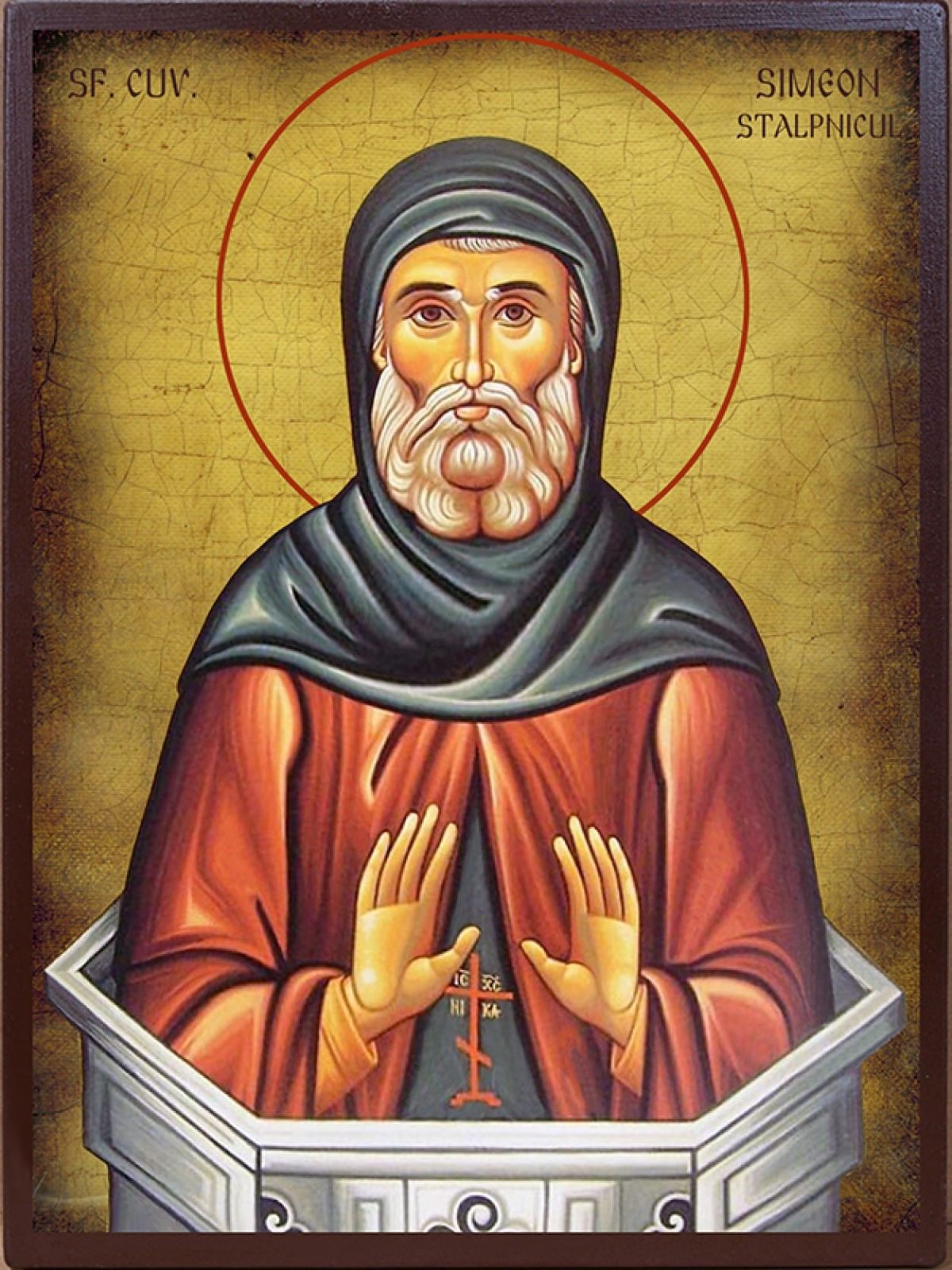
A man standing on a pillar.
A man who withdrew from nearly everything the world considers necessary for a meaningful life and spent his years turned toward God in prayer.
September 1 is both the beginning of the Church New Year, the Indiction, and the feast of St. Simeon the Stylite. The Church's appointed Gospel for the Indiction places Christ in the synagogue proclaiming from Isaiah the coming of the “acceptable year of the Lord.”
A severed head.
A man on a pillar.
And Christ announcing a new year.
Perhaps the Church is trying to tell us something about time.
We have a strange relationship with time.
We speak of having it.
Saving it.
Wasting it.
Killing it.
Making it.
Losing it.
As though time were something stored somewhere in our possession.
We open our calendars and divide our lives into little squares. We measure the day in meetings and meals, deadlines and commutes, birthdays and anniversaries. We tell ourselves that once this week is over, once this semester is finished, once the children are older, once we make enough money, once we lose the weight, once we find the person, once we receive the promotion, once things finally calm down -
then we will live.
Then we will pray.
Then we will forgive.
Then we will call our mother.
Then we will visit our father.
Then we will reconcile.
Then we will become the person we keep promising God we intend to become.
There is always another then.
And meanwhile, quietly, almost politely,
our life is happening.
This may be one of the great spiritual tragedies of the human person:
that we can spend an entire lifetime waiting for our life to begin.
The Church understands time differently.
On September 1, she does not simply tell us that another year has arrived.
She blesses time.
She places the year before God.
Her hymn calls Him the Creator and Master of time and the ages and asks Him to bless the course of the year.
Because Christianity does not ultimately teach us how to acquire more time.
Christianity teaches us how to consecrate the time we have already been given.
There is a difference.
A frightening difference.
Because if the problem were merely that we did not have enough time, then perhaps we could blame the clock.
But what if we have been given enough time to love?
Enough time to repent?
Enough time to forgive?
Enough time to become merciful?
Enough time to whisper one sincere prayer?
Enough time to sit beside someone who is lonely?
Enough time to say, I was wrong.
Enough time to say, I love you.
Enough time to say, Lord Jesus Christ, Son of God, have mercy on me.
Perhaps holiness has never required a longer life.
Only a surrendered one.
John the Baptist understood this.
His life is almost incomprehensible to the modern imagination because John never appears particularly interested in becoming the protagonist of his own story.
He points.
That is almost his entire existence.
He points toward Christ.
He gathers disciples, and then allows them to leave him for Christ.
He acquires influence, and refuses to build a kingdom around himself.
He becomes famous, and says that Another must increase while he must decrease.
And finally, when truth places him before Herod, John refuses to purchase another day of life with a lie.
Think about that.
He could have softened the language.
He could have become diplomatic.
He could have convinced himself that remaining alive would allow him to accomplish more good later.
Surely the great Forerunner could have found some sophisticated justification for silence.
But John had already given his time away.
That is why Herod could take his head but could not take his life from him in the deepest sense.
His life had already been offered.
The world thinks freedom means preserving as many options as possible.
John shows us another freedom:
having only one thing left to lose,
and having already given it to God.
And then comes Simeon.
The contrast almost feels intentional.
John's holiness is loud.
A voice crying in the wilderness.
Simeon's holiness is still.
A body remaining in one place.
John confronts a king.
Simeon confronts himself.
John's witness ends in the violence of a banquet hall.
Simeon's witness stretches through years of prayer, fasting, exposure, solitude, and endurance.
Yet the two men say almost the same thing:
A human life does not become precious by being prolonged. It becomes precious by being offered.
St. Simeon first encountered the Beatitudes as a young man, and their words pierced him deeply enough to alter the direction of his entire life. He eventually embraced an extraordinarily austere life of prayer and became known for dwelling atop a pillar, seeking above all the things of God.
And there is something almost offensive about him to our age.
Because we move constantly.
We travel.
We scroll.
We refresh.
We produce.
We consume.
We reinvent ourselves.
We fear missing out.
We measure a day by how much occurred inside it.
And Simeon stands still.
Year after year.
While empires move.
While merchants travel.
While armies march.
While people are born and buried.
While generations change beneath him.
Simeon remains.
Not because time means nothing.
But because time means too much to waste it becoming distracted from eternity.
Perhaps that is what stillness actually is.
Not the absence of movement.
But the refusal to run from God.
Most of us will never stand on a pillar.
We are not asked to.
Most of us will never stand before Herod.
We may never face martyrdom.
But every one of us will eventually stand before something much quieter.
A bedside.
An empty chair.
A grave.
A photograph.
A room that still contains the belongings of someone who no longer walks through its door.
And suddenly all the things we thought were urgent will become strangely small.
We will not wish we had answered more emails.
We will not wish we had won more arguments.
We will not wish we had spent more evenings proving ourselves to strangers.
We will want one more ordinary Tuesday.
One more cup of coffee at the kitchen table.
One more phone call.
One more car ride.
One more opportunity to hear that laugh.
One more chance to say what pride kept us from saying.
One more chance to apologize.
One more chance to forgive.
One more chance to pay attention.
And perhaps this is why the Church keeps teaching us to remember death.
Not because Christianity is obsessed with dying.
But because only the remembrance of death teaches us how astonishing it is that today exists at all.
You woke up this morning.
Do not pass too quickly over that sentence.
You woke up.
Someone did not.
The room appeared again.
The light entered the window again.
Your lungs filled again.
Somebody you love still exists somewhere beneath the same sky.
There are people you can still call.
There are wounds you can still attempt to heal.
There are prayers you can still begin.
There is still bread.
Still water.
Still Liturgy.
Still repentance.
Still the possibility of beginning again.
We call these things ordinary because they happen often.
Perhaps Heaven calls them mercy.
And this is where the Ecclesiastical New Year becomes so much more than a liturgical curiosity.
The Church is not handing us another calendar.
She is placing another year into our trembling hands and saying:
Offer it.
Not tomorrow.
Not when you become holier.
Not when life becomes easier.
This one.
This hour.
This aging body.
This imperfect family.
This unfinished vocation.
This apartment.
This marriage.
This loneliness.
This grief.
This talent.
This weakness.
This table.
This morning.
This very breath.
Consecrate it.
Because God does something astonishing with what we give Him.
Bread becomes Communion.
Wine becomes Blood.
Water becomes a grave and womb in Baptism.
Oil becomes healing.
A wooden Cross becomes the throne of the King.
A tomb becomes the doorway of Resurrection.
And time -
ordinary, vanishing, merciless time -
can become the place where eternity begins.
There are two Greek words that Christian writers often distinguish when speaking about time.
Chronos is the time we count.
Minutes.
Hours.
Years.
The clock.
Kairos is the appointed moment - the moment pregnant with encounter, decision, grace.
We spend much of our lives begging God for more chronos.
One more year.
One more opportunity.
One more season.
One more chance.
But perhaps God is constantly giving us kairos.
Now.
Now forgive.
Now return.
Now pray.
Now embrace your child.
Now sit with your father.
Now tell your mother what she means to you.
Now stop rehearsing the offense.
Now make peace.
Now go to confession.
Now receive Christ.
Now become gentle.
Now become grateful.
Now.
The spiritual life may ultimately depend upon our willingness to stop asking God for another life and begin giving Him the life that is already happening.
John had his prison.
Simeon had his pillar.
You have whatever stands before you today.
And perhaps sanctity is not found in escaping the place where we have been placed, but in allowing that place to become an altar.
John's prison became an altar.
Simeon's pillar became an altar.
The widow's two coins became an altar.
The thief's cross became an altar.
The Virgin's womb became an altar.
Your life can become one too.
Not when it becomes impressive.
When it becomes offered.
There is something else I cannot stop thinking about.
John dies at a banquet.
People are eating.
Drinking.
Celebrating.
Music is playing.
Promises are being made carelessly.
And somewhere beneath all of that noise, a righteous man is being murdered.
It is almost an icon of the human condition.
The world can be very loud while something eternal is happening quietly underneath it.
Perhaps this is why we need silence.
Because the most important things in our lives rarely announce themselves.
The last ordinary conversation with someone we love does not introduce itself as the last.
The final time we carry a child to bed does not tell us that someday they will become too heavy, and then too old, and then they will no longer ask.
Our parents grow older in increments too small to frighten us.
Our own faces change gradually enough that we barely notice.
One day becomes another.
Summer becomes autumn.
Years disappear disguised as ordinary afternoons.
And then one day we look backward and realize:
that was my life.
Those mornings.
Those meals.
Those commutes.
Those people.
Those tiny rooms.
Those arguments that seemed so important.
Those hugs I hurried through.
Those phone calls I almost didn't answer.
That was it.
That was the treasure.
Maybe this is what St. Simeon knew from atop his pillar.
Maybe stillness allowed him to see what motion hides from us:
that life is not rushing toward eternity.
Life is already touching it.
And perhaps John knew the same thing when the executioner came.
The moment belonged to God.
So he did not have to possess the next one.
What extraordinary freedom.
To reach a place where one no longer says,
Lord, give me more life so that I may finally give myself to You.
But instead:
Lord, whatever remains is Yours.
September 1 comes quietly.
No ball drops.
No crowds count backward.
The Church simply begins again.
She places Christ before us proclaiming the acceptable year of the Lord.
And perhaps hidden inside that Gospel is one of the tenderest things God ever tells humanity:
You are still here.
Come home.
There is still time.
Not infinite time.
Not guaranteed time.
Not time we own.
But this moment.
And perhaps this moment is enough.
Enough to repent.
Enough to love.
Enough to begin again.
Enough to turn our face toward Christ.
So maybe the prayer for this New Year should not be:
Lord, give me more time.
Maybe it should be:
Lord, teach me what to do with the time You have already given me.
Teach me not to hurry past the people I prayed for.
Teach me not to call blessings ordinary simply because they arrived quietly.
Teach me to recognize the last times before they become memories.
Teach me to speak truth like John when silence would be easier.
Teach me to become still like Simeon when distraction would be easier.
Teach me to stop measuring my life only by what I have accomplished and begin measuring it by what I have loved.
Teach me to remember that every person before me is temporary.
That I am temporary.
That this world, in its present form, is passing.
And because it is passing -
teach me to love it rightly.
Not possessively.
Not desperately.
But eucharistically:
receiving everything with thanksgiving,
and returning everything to You.
My youth.
My aging.
My gifts.
My failures.
My family.
My unfinished dreams.
My days.
My years.
My beginning.
My end.
All of it.
Because someday there will be no September 1 left for us.
No next year.
No later.
No someday.
There will only be the life we were given and the love with which we offered it back.
And perhaps, when that hour comes, we will finally understand:
God was never withholding eternity from us.
He had been placing it quietly inside every moment all along.
We were simply learning how to see it.
God does not give us more time.
He teaches us to consecrate it.