✦ The First Meditation ✦
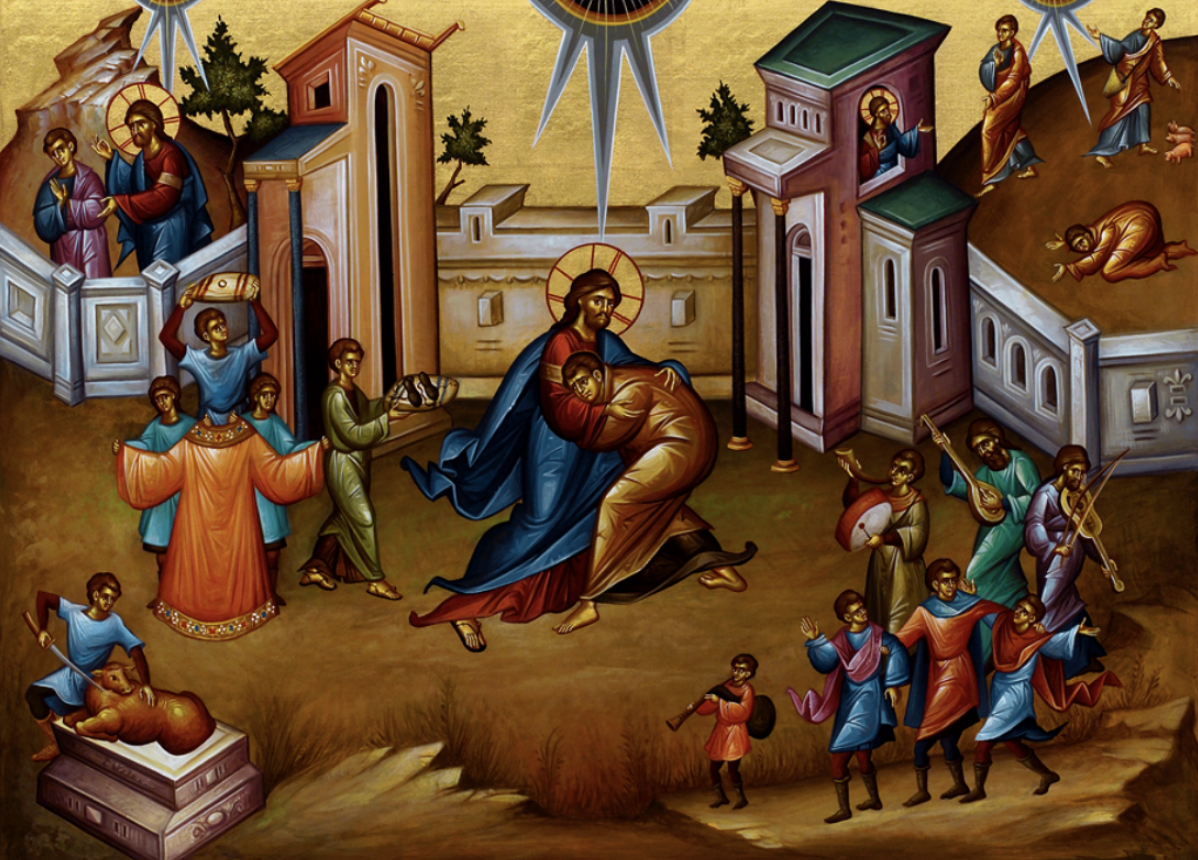
The Forgiveness
That Opens the Fast
On Cheese Fare Sunday, the Church does something quietly devastating. Before she asks anything of us, she asks us to bow to one another.
There is candlelight in the nave. The choir has just finished, and the last note is still dissolving into the cold air of the church : that particular cold that stone buildings hold even in February, even with a hundred bodies pressed together in the dark. And then the priest turns from the altar, and the thing begins that I did not know I needed until I was standing in the middle of it.
Forgiveness Vespers. The rite where we bow - priest to people, people to priest, and then, slowly, to one another. Person by person. Face by face. "Forgive me, a sinner." And the reply, offered back like a gift you did not expect to receive: "God forgives. And I forgive." The words are old. The gesture is older. And somehow, every year, they undo me completely.
Tonight I stood in that line and I thought about how I came to be here. About the long road. About all the years I spent at arm's length from God - not hostile, just distant, the way you can be distant from something you love but are afraid to need too much. And I thought about the people who kept gently, persistently, lovingly, refusing to let me stay distant.
✦ ✦ ✦
I should say something, before anything else: this is the first post on this blog. And I almost didn't write it... almost didn't write any of this... because who am I to say anything about the Fathers? I am not a theologian. I have no title. What I have is an annotated copy of the Philokalia with tea stains on the pages, and a phone full of voice memos sent to me by people who love me, telling me to start writing.
My mother was the first. Then, a close friend, who is not even Orthodox but who has sat across from me through more conversations about theosis and divine light than any non-Orthodox person should ever have to endure. Then my father , who said — with the particular bluntness that only a father can deploy : "Teo, you talk about this stuff constantly. Just write it down." And then others, one by one, saying versions of the same thing.
I am not sure I would have listened to any one of them. But all of them together... now that is a different thing. That begins to feel less like encouragement and more like a kind of grace. So this is, in the deepest sense, not mine alone. It is something I was pushed into by love, which I have been told is the only way any good thing begins.
Let no one depart carrying the burden of anger. Let no one go home while his brother remains estranged from him.
St. John Chrysostom
It is to Chrysostom that I want to turn tonight. The Golden-Mouthed, as they called him - not because his words were ornate, but because they burned. He was a man who could preach to emperors and make them feel, for a moment, that the poor man at the city gate mattered more than their throne. He was also a man who was exiled for it. Twice. And who, dying alone on a road in Pontus, reportedly said his last words with something approaching joy: "Thanks be to God for all things."
This is the man who wrote about forgiveness. And what strikes me - what has always struck me - is that for Chrysostom, forgiveness is not merely a moral virtue. It is not even primarily about the one who wronged you. It is about what unforgiveness does to the soul that carries it. It is a medical diagnosis as much as a moral teaching. He sees the unforgiving heart and he sees something decaying. Something slowly becoming unlike God.
St. John Chrysostom - On the Gospel of Matthew
"Nothing makes us so like God as being ready to forgive the wicked and the wrongdoer. For it is God's peculiar glory to see the one who has sinned against Him and to desire his salvation, not his punishment."
Read that slowly. Not his punishment. God's peculiar glory : that magnificent, counter-intuitive, world-inverting word peculiar - is to desire not the punishment of the one who has sinned against Him, but his salvation. To want, for the one who turned away, nothing but homecoming.
I stood in the nave tonight and bowed to a woman I have had difficult words with. It does not matter who she is. What matters is that in the moment of bowing, something cracked open in me that I had not known was sealed. I said the words. She said them back. And in the space between the saying and the receiving, something happened that I cannot fully account for, only that it felt less like a ritual and more like a rescue.
This is what Chrysostom knows. That the bow is not theater. That the words are not polite liturgical fiction. That when the Church orders us : before the fast even begins, before we have denied ourselves a single thing - to first empty ourselves of grievance, she is not asking us for a warm-up exercise. She is asking us for the hardest thing. And she is asking it first, before anything else, because without it, the fast is merely hunger. Only with it does hunger become prayer.
✦ ✦ ✦
I did not expect, when I walked into Vespers tonight, to leave wanting to write. I expected to leave quiet - the good kind of quiet, the kind that the services produce in you if you let them, the kind that is not empty but full. And I did leave quiet. But underneath the quiet there was something else pressing upward, and I have learned, slowly, to not ignore that feeling. My friends and family would say, probably with some exasperation, that it took me long enough to learn it.
They are right. It did. But here I am. And if you are reading this - stranger, friend, fellow traveler on whatever road you are on - I am grateful you are here. I do not know what this blog will become. I only know that tonight, on the threshold of the Great Fast, standing in candlelight with the smell of incense still in my coat, I felt, for the first time in a long time, that I had something worth trying to say.